
The sequence pattern
The 4, 5 and 6 of hearts form a sequence: the ranks are consecutive and the suit stays the same. The length can be greater than three where the rules allow it.
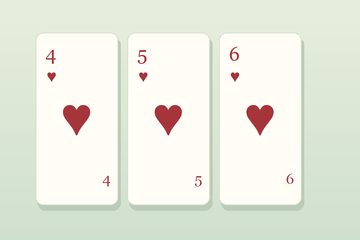
The suit symbols matter. A red diamond and a red heart share a colour, but they are different suits. Colour alone does not make cards part of the same run.
Spot the missing connection
| Cards | What to notice |
|---|---|
| 4♥ 5♥ 6♥ | Consecutive ranks, all hearts. |
| 4♥ 6♥ 7♥ | The five is missing; these are not an unbroken run. |
| 4♥ 5♦ 6♥ | The five is a diamond, so the suits do not match. |
| 7♣ 8♣ 9♣ 10♣ | A longer consecutive run in clubs. |
Pure sequences and joker substitutions
In formats that use the term, a pure sequence is formed without a joker standing in for a missing card. An impure sequence uses an allowed joker substitution. Not every rummy variant uses jokers or this terminology.
For example, where substitutions are permitted, 4♥, a joker representing 5♥, and 6♥ can illustrate the idea of a substituted run. Whether it satisfies a particular hand requirement must be checked against that game’s rules.
Where does an ace fit?
Some variants put the ace below the two. Others also allow it above the king. The treatment of Q-K-A and K-A-2 is therefore a rule question, not something to infer from an image.